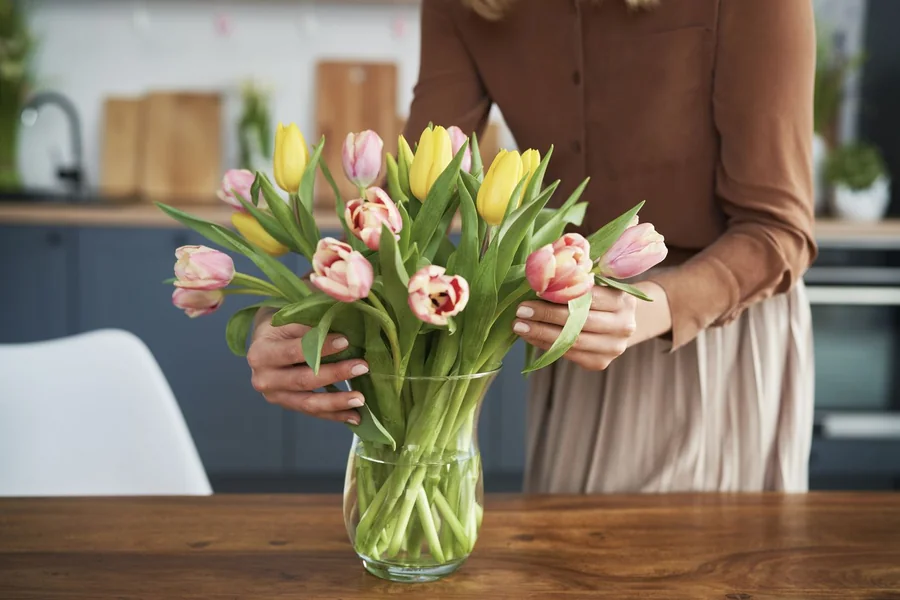
Tulips are beautiful and delicate flowers that you can bring to your home, but are also very sensitive as far as taking care of them is concerned. How many tulips in vase are necessary to keep them fresh and alive is indeed one of the most frequent questions that people pose. This is what can be the difference between a flower that endures a week or one that withers in a couple of days. It is good news that tulips do not need much to take care of, once you know their simple requirements. By using the right quantity of water, setting them in the correct location, and making few simple routines, you can indulge in their beauty over a lot longer.
Learning about Tulips and their Water requirements
Tulips do not wither away even after being cut as many other cut flowers do. Their stems may extend and curve towards light sources and thus a bit peculiar to maintain. This continuous expansion implies that they all the time absorb water but do not need a vase filled to the brim.
Generally, tulips like moderation of water as opposed to a complete vase. Tulips are not so fond of deep water as roses are, but will do well when the bottom of the stems is in water. Excess water may make the stems grow soft and even make them fall at an increased rate.
The other key aspect to be kept in mind is that tulips are very sensitive to the surrounding. The quality of water, its temperature and cleanliness all contribute to the quality of their maintenance. Then as much as the quantity of water counts, so does the manner in which you handle it.
Just How Many Water in Tulips in Vase?
As to the precise measure, the perfect amount of water in the vase is some 2 to 3 inches (5 to 8 cm) of water. This is sufficient to maintain stems hydrated without saturating it.
These are some few basic steps to be taken:
- Fill the vase with a little of cold water.
- Make certain that submerged stems are only on the lower part.
- Do not over fill the vase.
Tulips absorb water at a very rapid rate and hence you will find the level going down more rapidly than you had thought. Rather than watering the vase to the full capacity, it is preferable to keep on topping up the water. This makes the stems hard and does not allow growth of bacteria.
Maintaining water level also contributes towards the tulips being in their natural upright position. When they are too much submerged, the stems will be feeble and begin to bend over.
Tulips: Best Practices to maintain longer fresher
The supply of appropriate quantity of water is only the start. There exist some other habits which can prolong the life of your tulips.
Begin by cutting the stems at an angle of small degree then put them in water. This enhances the area to take in water and keep the flowers moist. The stems should be re-trimmed after every couple of days to ensure that they are kept fresh.
It is preferable to change water every day. Tulips are also sensitive to bacteria and dirty water is likely to cut their life span in a short period. Fresh water enables the stems to be healthy and avoids foul odors.
Keep the vase in a cool place and not in the line of the sun and sources of heat. Tulips are sensitive to high temperatures, and high temperatures will make them dry at a quicker rate.
They should also not be put in areas where fruits are getting ripe. Fruits emit gas that is called ethylene that accelerates the process of aging flowers.
Errors that are made by most people
By a few simple mistakes many of us end up shortening the life of our tulips. One of them is filling up the vase with water to an overflowing brim. It may be reasonable to provide flowers with more water, yet tulips are not responsive to it.
The other error is that of failing to replace the water. Although the water may appear clean, there is always a chance of bacteria building up and damaging the stems.
Other individuals also do not remember to trim the stems after the initial set up. The terminals of stems may end up sealing with time, thus decreasing their capacity to absorb water.
Another problem is with the location of the tulips, which should be either warm or in the sun. Although they might be pretty in a sunny windowsill, they will soon fade after the heat.
Lastly, a dirty vase might be used initially, which may give bacteria the initial push. You should never leave dirty water in your vase and put fresh water and flowers in.
Additional Advice on how to arrange Tulips in a Vase
Tulips tend to move and bend, it is natural and can even be a plus to your arrangement. Nevertheless, in case you want it to be more organized, you can employ some tricks.
Select a vase that will hold the stems but not crowd them. A slightly thinner vase is used to maintain the tulips in a straight position, and yet to allow them to move naturally.
It is also possible to loosely wrap the tulips in a piece of paper and put them in water a couple of hours. This will aid them in straightening in case they are curved.
In case you would like to have a creative combination, then combine tulips with other flowers. All you need to do is to ensure that the water and care needs of the flowers are similar.
The other tip that can be of use is to ensure that the leaves are not in the water. When the leaves are in water, they may rot and allow the bacteria to grow and this reduces the life of the flowers.
Final Thought
Knowledge on the amount of water to use in tulips in vase is important in keeping them fresh and beautiful. Clean water in a small quantity with frequent care can go a long way in making them live long. Tulips are fragile yet can also pay off in the right way. With proper water level, trimming the stems and cool environment, you may enjoy their graceful beauty several days.
FAQs
How much water should tulips have in a vase?
Tulips should have about 2 to 3 inches of water in the vase to keep them properly hydrated without weakening the stems.
Do tulips need a full vase of water?
No, tulips do not need a full vase of water and actually do better with a lower water level.
How often should I change tulip vase water?
You should change the water daily or at least every two days to prevent bacteria buildup.
Why are my tulips drooping in the vase?
Tulips may droop due to too much water, lack of fresh water, or exposure to heat and sunlight.
Can I add flower food to tulip water?
Yes, adding a small amount of flower food can help extend their freshness and provide nutrients.
Should tulip stems be cut before placing in water?
Yes, trimming the stems at an angle helps improve water absorption and keeps the flowers fresh.
Where should I place a vase of tulips?
Place the vase in a cool area away from direct sunlight, heat sources, and ripening fruits.
About the Author