

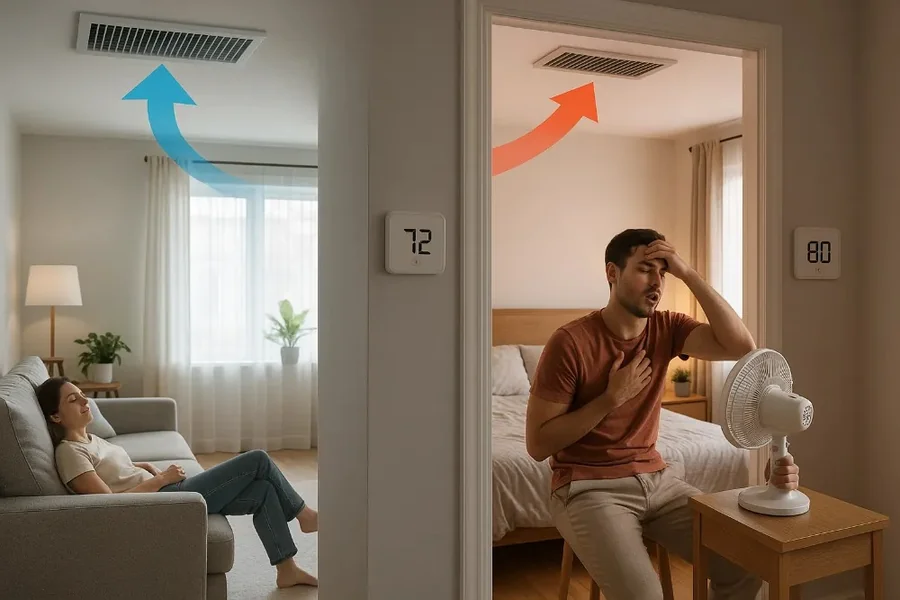
Uneven heating and cooling can make a home feel comfortable in one room and frustrating in the next. Homeowners often notice it in upstairs bedrooms, bonus rooms, spaces over garages, or areas far from the thermostat. The problem may seem simple at first, but temperature imbalance usually comes from several conditions working together. Airflow issues, duct leaks, insulation gaps, thermostat placement, and home layout can all affect how comfortable a home is. An HVAC contractor helps by identifying the cause instead of treating every hot or cold room as the same problem. That careful evaluation supports steadier comfort throughout the house.
What Contractors Check
-
Looking Beyond the Thermostat Reading
One of the first ways an HVAC contractor helps solve uneven heating and cooling problems is by looking beyond the thermostat reading. A thermostat only measures the conditions at its location, so it may not reflect how the rest of the house actually feels. If it sits in a hallway, it may shut the system off while bedrooms farther away still feel warm in summer or cool in winter. Contractors usually ask which rooms feel uncomfortable, at what time of day the problem worsens, and whether the issue varies by season. Those details help connect the complaint to real patterns inside the home instead of relying on one number from one wall. A contractor may also compare supply air at different vents, check return airflow, and see whether certain areas are receiving less conditioned air than others. This step matters because uneven comfort is often a distribution problem rather than a simple equipment failure.
-
Finding Airflow and Duct Problems
HVAC contractors also focus closely on the duct system and overall airflow, since many comfort problems begin there. A room can remain uncomfortable when ducts leak, bend sharply, deliver too little air, or fail to return enough air to the system. In some homes, one part of the house gets strong airflow while another barely feels anything at the vent, even though both are connected to the same equipment. Closed dampers, blocked vents, dirty filters, and poor return paths can all contribute to that imbalance. A homeowner searching for answers may come across Gee Heating & Air of Alpharetta, but the real issue still needs to be traced to whether the discomfort is starting in the duct network rather than in the unit alone. Contractors often inspect visible duct sections, look for disconnected joints, and measure how much air reaches each room. When airflow improves, the house usually starts feeling more even without forcing the equipment to run harder than necessary.
-
Checking Insulation, Sun Exposure, and Home Layout
Another important part of the process is evaluating the house’s structure. The furnace or air conditioner does not always cause uneven heating and cooling. A contractor may notice that one side of the home receives intense afternoon sun, that an upstairs room sits directly beneath a hot roofline, or that certain windows allow excessive heat gain or loss. Ceiling height, open floor plans, attic conditions, insulation levels, and room placement can all affect how quickly a space changes temperature. A bonus room above a garage often behaves differently from a bedroom surrounded by conditioned space, even if both receive air from the same system. By studying these conditions, the contractor can explain why some rooms drift away from the set temperature more easily than others. This matters because a home may need a combination of airflow adjustments and building improvements instead of a single repair that only treats the symptom.
-
Matching the Solution to the Actual Cause
Once the source of the imbalance becomes clearer, the contractor can recommend a solution that actually matches the problem. Some homes need duct sealing, vent adjustment, or stronger return airflow. Others may benefit from zoning controls, thermostat relocation, blower setting changes, or a review of whether the current system is properly sized for the house. In certain cases, the answer is not a full replacement but several smaller corrections that allow the existing system to perform more evenly. Contractors may also point out that closed interior doors, crowded vents, and neglected filters can affect room comfort more than many homeowners realize. The goal is not simply to push more heating or cooling into the house. The goal is to make delivery more balanced, so each area feels closer to the temperature the system aims to maintain. When the solution matches the cause, comfort usually becomes steadier and less frustrating in everyday life.
More Even Comfort Over Time
An HVAC contractor helps solve uneven heating and cooling problems by studying how the whole home behaves, not just by checking one piece of equipment. That work may involve reviewing thermostat placement, duct performance, airflow balance, insulation condition, and how sunlight or layout affects certain rooms. Once the cause is identified, the contractor can recommend changes that improve how comfort is delivered throughout the house. Hot and cold spots rarely disappear through guesswork alone. They improve when the problem is clearly understood and addressed in a way that fits the actual conditions in the home each day for everyone.
